
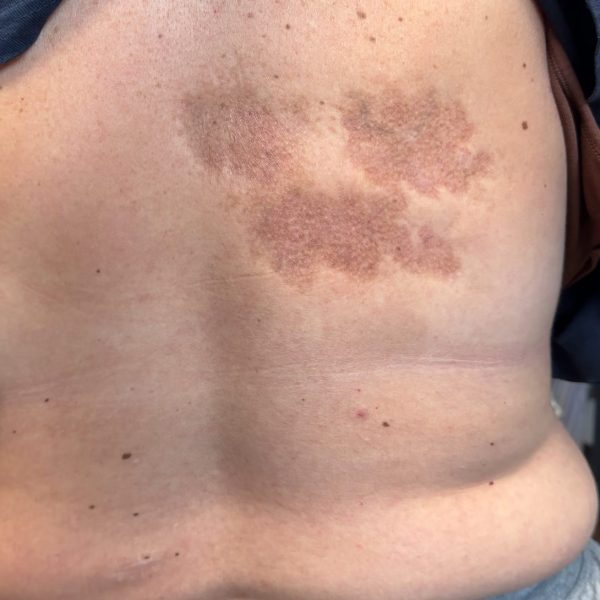
Localized morphea, often referred to as localized scleroderma, is a rare skin condition that causes patches of thickened, hardened skin due to excess collagen deposition. Unlike systemic scleroderma, morphea is confined to the skin and underlying tissues, without affecting internal organs. This condition typically presents as oval or linear plaques that start as reddish or purple discoloration before progressing to smooth, firm, and sometimes waxy-looking areas. Over time, these lesions may become atrophic, leaving behind skin that appears bound down or “shrink-wrapped.” Localized morphea most commonly affects the trunk, but it can also appear on the limbs or face.
Diagnosis is primarily clinical, based on the characteristic appearance of the lesions. In some cases, a skin biopsy may be performed to confirm the diagnosis by revealing excessive collagen deposition and inflammatory changes in the dermis. While the exact cause remains unknown, localized morphea is thought to be an autoimmune-mediated condition, sometimes triggered by trauma, radiation, or infections.
Treatment options vary depending on disease severity and progression. Mild cases may improve spontaneously over time, but active or symptomatic lesions often require intervention. First-line treatments include topical corticosteroids and calcineurin inhibitors to reduce inflammation, while phototherapy (UVA1 or narrowband UVB) can be effective for more widespread or deeper lesions. In cases where the disease is rapidly progressing or causing functional impairment, systemic immunosuppressants like methotrexate may be prescribed. Physical therapy may also help maintain mobility if lesions restrict movement. While localized morphea is not life-threatening, early recognition and treatment can help prevent permanent skin changes and functional limitations.
The image showcases a classic presentation of localized morphea on a patient’s back, highlighting the characteristic thickened, discolored plaque with a waxy, atrophic center—demonstrating why this condition is sometimes referred to as “skin frozen in time.”
Disclaimer: The photos shown are actual images of our patient, shared with explicit written consent. These images are for educational use only and may not be copied, distributed, or reproduced without permission from our office.